How to Study Maths Effectively: Twenty of the Same Sum Is the Worst Homework There Is
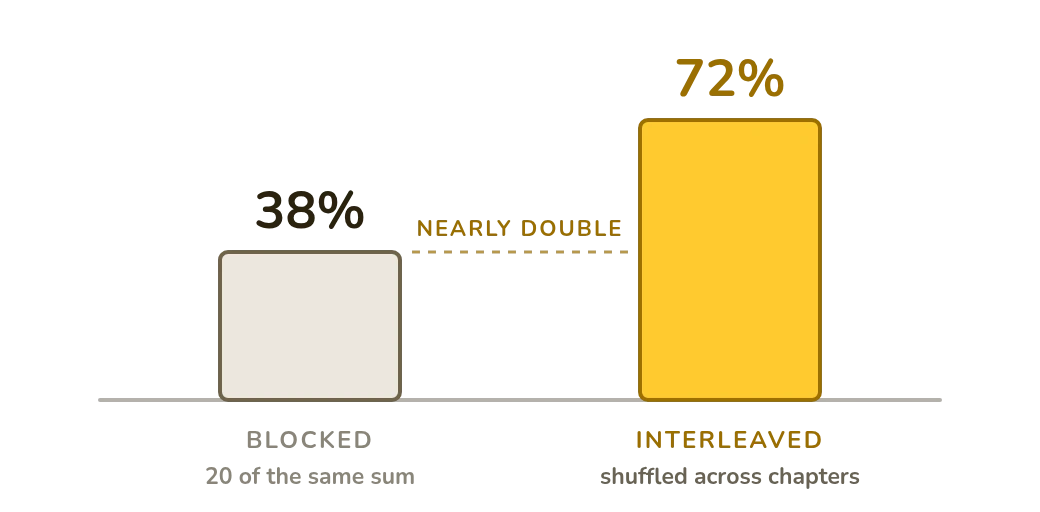
How to study maths effectively: mix the questions. In a classroom study of 140 grade 7 students, shuffled practice scored 72% on an unannounced test, against 38% for one-chapter-at-a-time practice. Blocked worksheets remove the hardest decision - which method applies - so the skill the exam tests is never practised. Five mixed questions is the fix.
Two groups of grade 7 students. Same problems, same total practice, same teachers. One group did them in blocks - one kind of problem at a time. The other did exactly the same problems, shuffled. After nine weeks of practice came an unannounced test, two weeks after the last session.
The blocked group scored 38%. The mixed group scored 72%.
That isn’t a tweak. It is close to double, from changing nothing except the order the questions came in.
Why the normal way feels better and works worse
Open almost any maths worksheet and it’s twenty questions from one chapter. Twenty fraction sums. Twenty area problems.
Here’s what that does. After the second question, your child no longer has to work out what kind of problem this is. The chapter heading already told them. They’re executing a method, over and over, with the hardest decision removed.
It feels wonderful. Accuracy climbs through the page, the homework gets finished, and the marks look fine. Blocked practice reliably produces confidence and unreliably produces learning.
Then the exam arrives with questions from eleven chapters in no particular order, and the one skill that was never practised - deciding which tool this situation needs - turns out to be the whole test.
The study
Rohrer, Dedrick and Burgess ran this in real classrooms: a public middle school in Tampa, three teachers, eight grade 7 maths classes, 140 students. Practice ran across nine weeks. The test came two weeks after the last session, and was unannounced.
Interleaved 72%, blocked 38%, with an effect size of d = 1.05 - enormous by the standards of education research, where 0.4 is often treated as a strong result.
A companion study by the same group with 126 students found d = 0.42 on a test one day after practice ended and 0.79 after thirty days. Which tells you something important: the longer you wait, the bigger the advantage gets. Blocked practice doesn’t just teach less. It teaches things that evaporate.
One honest note on what this does not say. Interleaving is harder in the moment, and scores during practice are usually worse than blocked practice. Children find it less pleasant and feel less confident. The gain shows up later, on the test. If you try this tonight and your child struggles more than usual, that is the mechanism working, not failing.
The five-minute fix
Pick five questions from five different chapters. Shuffle them. Hand them over.
That’s it. Not more questions - the same number, from different places.
And then watch what happens, because the useful information isn’t the score.
Watch where they pause. The pause is the gap.
A child who knows the method but can’t tell which one applies will stop before writing anything. That hesitation, in front of a question whose chapter you haven’t named, is the most honest diagnostic available at a kitchen table - and it is invisible on a normal worksheet, because the worksheet answers the question for them.
Three practical notes:
Use old chapters, not just the current one. The point is making them choose. Five questions from the chapter they’re on this week isn’t mixed practice, it’s blocked practice with extra steps.
Don’t label them. The moment you say “these are the ratio ones”, you’ve rebuilt the scaffolding you were trying to remove.
Expect it to go worse than usual, and say so beforehand. “These are mixed on purpose, so they’re meant to feel harder” costs nothing and prevents a child concluding they’ve gone backwards.
Why this one matters more than most study tips
Most revision advice is about effort or scheduling. This one is about a specific, nameable skill that school systematically under-practises: recognising what kind of problem you’re looking at.
It’s the same gap we keep coming back to - the child who can divide perfectly but can’t tell that a word problem needs division. Knowing the process is common; knowing when to use it is rare, and it’s where marks actually go from about grade 6 onwards.
Mixed practice is the only homework format that trains it directly. It costs nothing and takes five minutes to set up.
Frequently asked questions
What is interleaved or mixed practice?
Practising different types of problem shuffled together rather than one type at a time. The child has to work out which method applies to each question instead of being told by the chapter heading.
How much better is it?
In a classroom study of 140 grade 7 students, mixed practice produced 72% on an unannounced test two weeks later, against 38% for blocked practice - an effect size of d = 1.05. A companion study found the advantage grew over thirty days.
Won’t my child just do worse?
During practice, probably yes. Interleaving feels harder and produces lower scores in the moment. The benefit appears on delayed tests. Warn them in advance so the extra difficulty doesn’t read as failure.
How do I actually do this?
Five questions from five different chapters, shuffled, unlabelled. Use older chapters as well as the current one, and watch where they hesitate.
Does this replace normal homework?
No. Blocked practice is reasonable when a method is brand new and the child is still learning the steps. The mistake is staying there - once the method works, mixing is what makes it stick.
Does it work for subjects other than maths?
The research is strongest in maths, where problem types are clearly distinct. The underlying principle - forcing retrieval and discrimination rather than repetition - is general.
Related reading
- Four Questions Worth Eight Months of School - the confidence question gets far more interesting when the problems are mixed.
- Understands It in Class, Blanks in the Exam - why a child who knows the methods still freezes on the paper.