CBSE Class 10 Maths Exam Pattern 2027: What Actually Changed (and What Didn’t)
The CBSE Class 10 maths exam pattern for 2027 has not changed. CBSE’s own Mathematics Standard sample paper for 2026–27 says so on every page: 38 compulsory questions, 80 marks, three hours, no calculator. The move to competency-based questions happened in 2023, when CBSE raised them from 40% to 50% of the paper, and the share has held since.
- 10 practice questions - solve them right here
- Answers - with the step most students miss
The paper design has not changed for 2026–27. CBSE prints that on every single page of its own Mathematics Standard sample paper: “There is no change in the Question Paper Design and Assessment Pattern for Academic Session 2026-27.” Six pages, six times.
If you’ve read that the board is “moving to application-based questions” this year, that’s two or three years late. The shift already happened, it has been in every paper your child has seen, and the useful question now is not what changed but how to answer the half of the paper that was never about recall.
The blueprint, from the official paper
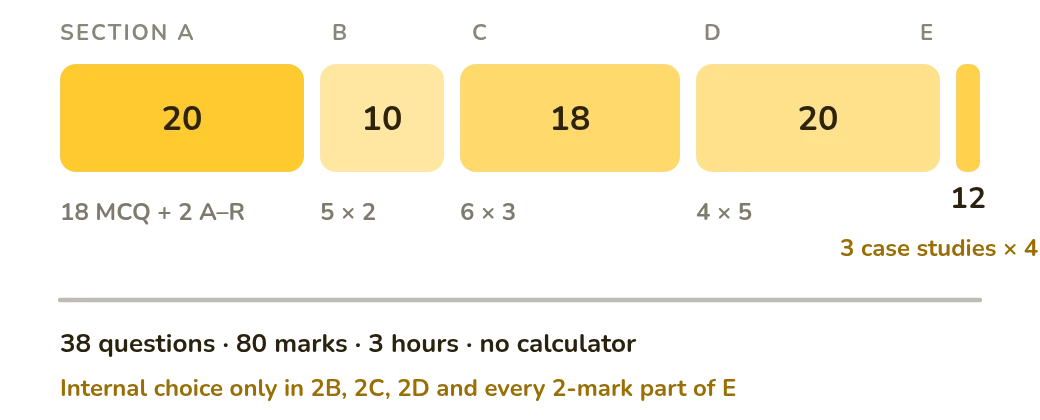
Mathematics Standard (041), 80 marks, three hours, 38 questions, all compulsory.
| Section | Questions | Type | Each | Total |
|---|---|---|---|---|
| A | 1–18 | Multiple choice | 1 | 18 |
| A | 19–20 | Assertion–Reason | 1 | 2 |
| B | 21–25 | Very short answer | 2 | 10 |
| C | 26–31 | Short answer | 3 | 18 |
| D | 32–35 | Long answer | 5 | 20 |
| E | 36–38 | Case study | 4 | 12 |
Three details worth knowing, because they change how you revise:
There is no overall choice. Internal choice appears in exactly 2 questions in Section B, 2 in Section C, 2 in Section D, and in every 2-mark sub-part of Section E. Nowhere else. You cannot skip a chapter and hope.
Every case study has the same shape - sub-parts of 1, 1 and 2 marks, with the 2-mark part offering a choice. That’s predictable enough to practise directly.
Calculators are not allowed, and π is taken as 22/7 unless stated.
When it actually changed: 2023
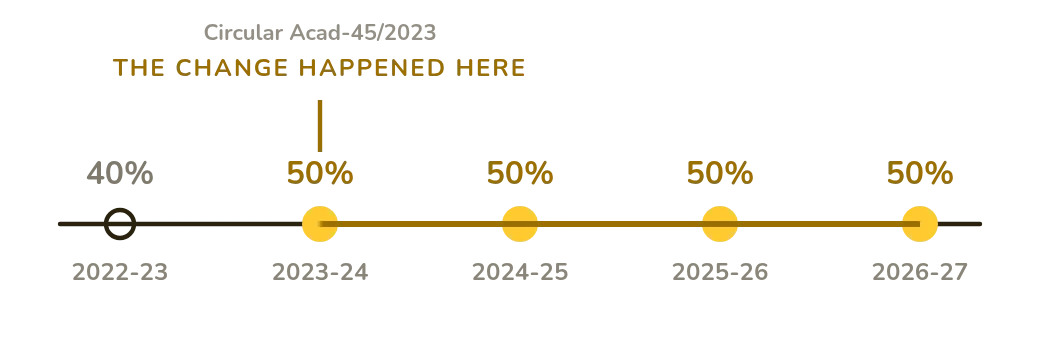
CBSE circular Acad-45/2023, dated 6 April 2023, raised competency-focused questions for Classes 9 and 10 from 40% to 50% of the paper. The widely quoted split since then has been roughly 50% competency-focused, 20% multiple choice, 30% short and long answer.
That share has held through 2024–25, 2025–26 and now 2026–27. Articles announcing it as a 2026 or 2027 change are recycling an old circular.
What has kept moving is subtler and more important: the questions inside the unchanged structure keep getting more context-led, including in Section A, where most students assume they’re safe.
What “competency-based” actually looks like
It does not mean harder arithmetic. It means the question doesn’t tell you which tool to use.
Here are three from CBSE’s own 2026–27 sample paper, which tell you more than any description.
A one-mark MCQ: The greatest number which divides both 134 and 188, leaving remainders 4 and 6 respectively. There’s no “find the HCF” instruction. You have to notice that the number divides 130 and 182 exactly - and only then is it an HCF question.
A one-mark MCQ: Tarun correctly solved a pair of linear equations and found their only point of intersection as (5, −1). One of the lines was x − y = 6. Which of the following could have been the other line? You aren’t solving anything. You’re reasoning about what “only point of intersection” rules out.
A five-mark question: a rectangular park with a pool in the middle and a uniform grass strip, given the area of the strip. The quadratic is easy. Setting it up, and then rejecting the root that would make a dimension negative, is the whole question.
Notice what’s common. The arithmetic in all three is Class 8 level. The difficulty is in deciding what the situation is asking. That is exactly the gap we wrote about in why a right answer proves less than you think - and it’s the single most common reason a well-drilled student underperforms.
A competency practice set, with answers
CBSE’s own sample paper is free and you should download it first, from the CBSE academic site. What follows is additional practice in the same pattern - written to mirror the official style, with every answer independently verified.
I’ve given a focused set rather than a padded 38-question paper. These are the items students actually lose marks on.
Practise these here
Pick or type an answer and it will mark itself straight away - and tell you why, not just whether.
1The greatest number which divides 70 and 125, leaving remainders 5 and 8 respectively, is:
2One root of x² − 5x + k = 0 is 2. The other root is:
3Assertion (A): √2 is irrational. Reason (R): The square root of every prime number is irrational.
4The sum of a two-digit number and the number formed by reversing its digits is 99. The digits differ by 3. Find the number.
5Which term of the AP 7, 13, 19, … is 205?
6A bag has 5 red, 8 blue and 7 green balls. One is drawn at random. What is P(not blue)?
7A park is 60 m × 40 m with a pool in the middle, surrounded by a grass strip of uniform width. The strip has area 1344 m². Find the pool’s dimensions.
8A canteen sells samosas at ₹12 and sandwiches at ₹25. It sold 180 items for ₹2,940. How many samosas?
9A gym signs 5 members in week 1, 8 in week 2, 11 in week 3, continuing the pattern. How many in total over the first 12 weeks?
10Gate A is at (2, 3) and gate B at (10, 9). A fountain divides AB in the ratio 1 : 3 from A. Find its coordinates.
Want more practice papers? I post a fresh competency-style set most weeks, free, no sign-up. Say hello on X, LinkedIn or WhatsApp and I will send the next one across.
Question 7 is the one worth dwelling on. The quadratic takes thirty seconds. Rejecting x = 42 - because a 42 m strip inside a 40 m-wide park is impossible - is where the marks actually are, and it’s the move no amount of drilling teaches.
How to prepare for the half that isn’t recall
Download the official sample paper and marking scheme first. Both are free: the marking scheme shows exactly where the step marks sit. CBSE also publishes Competency-Focused Practice Questions for Class 10 maths, which most families never discover.
Practise reading, not solving. Take ten case studies and, for each, write only which chapter this is and what it’s asking - don’t solve any of them. Ten minutes, and it trains the exact skill the paper rewards.
Always sanity-check the answer against the situation. Negative lengths, fractional people, a 42 m strip in a 40 m park. Competency questions are built so that a careless answer is visibly absurd, and a child who never checks will hand one in.
Do Section E separately. Twelve marks, a fixed 1-1-2 shape, and the most predictable part of the paper. It is also where students run out of time, because they leave it last.
Write the working out. Stepwise marking means a wrong final answer with correct method still scores. Children who do it in their heads lose marks they had earned.
If the gap is wider than exam technique - if the fractions or the algebra underneath aren’t solid - that’s not a revision problem, and more past papers won’t fix it. That’s what one-to-one maths tutoring is for, and how each board’s maths differs has more on CBSE specifically.
Frequently asked questions
Has CBSE changed the Class 10 maths paper pattern for 2026-27?
No. CBSE’s own 2026-27 Mathematics sample paper states on every page that there is no change in the question paper design or assessment pattern for this session.
What is the CBSE Class 10 maths paper pattern for 2027?
38 compulsory questions over 80 marks in three hours. Section A: 18 MCQs plus 2 assertion–reason, 1 mark each. Section B: 5 questions at 2 marks. Section C: 6 at 3 marks. Section D: 4 at 5 marks. Section E: 3 case studies at 4 marks.
What percentage of the paper is competency-based?
About 50%, raised from 40% by CBSE circular Acad-45/2023 in April 2023. It has stayed at that level since.
What counts as a competency-based question?
One where the situation doesn’t name the method. Case studies, assertion–reason, and context questions where the first task is working out which chapter you’re in.
Is there a choice between questions?
No overall choice. Internal choice in 2 questions in Section B, 2 in Section C, 2 in Section D, and in every 2-mark sub-part of Section E.
Are calculators allowed?
No. Take π as 22/7 unless the question says otherwise.
Related reading
- CBSE Maths Basic vs Standard - same paper shape, different questions, and what the choice does to Class 11.
- Understands It in Class, Blanks in the Exam - the four different problems behind a bad board paper, and the fix for each.