CBSE Maths Basic vs Standard: The Choice That Decides Class 11
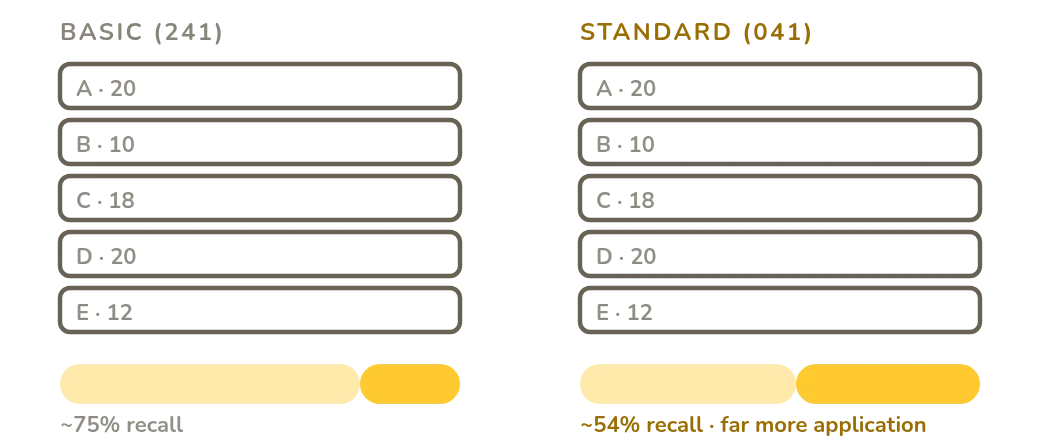
CBSE Maths Basic vs Standard comes down to the questions, not the paper: both have 38 questions, 80 marks, three hours and the same five sections. Basic gives about 75% of marks to recall and understanding, Standard about 54%. The bigger difference comes after the exam: Standard keeps Class 11 Mathematics open, and Basic restricts it.
The two papers have exactly the same shape. 38 questions, 80 marks, three hours, the same five sections, the same internal-choice pattern. Same syllabus taught in class, same internal assessment. The only thing that differs is how hard the questions inside that structure are.
Which makes this a much simpler decision than most articles make it - and a much higher-stakes one, because the consequence isn’t the exam. It’s what your child is allowed to study in Class 11.
First, two things that are not true
Basic has not been discontinued. You’ll find this claim online. CBSE’s own Class X sample paper page for 2026–27 lists Mathematics (Basic) and Mathematics (Standard) side by side, each with a sample paper and marking scheme. Both exist.
The formats are not different. Open both official sample papers - Basic and Standard - and the general instructions are near-identical:
| Basic (241) | Standard (041) | |
|---|---|---|
| Questions | 38, all compulsory | 38, all compulsory |
| Marks / time | 80 / 3 hours | 80 / 3 hours |
| Section A | Q1–18 MCQ, Q19–20 assertion–reason | Q1–18 MCQ, Q19–20 assertion–reason |
| Section B | Q21–25, 2 marks | Q21–25, 2 marks |
| Section C | Q26–31, 3 marks | Q26–31, 3 marks |
| Section D | Q32–35, 5 marks | Q32–35, 5 marks |
| Section E | Q36–38 case study, 4 marks | Q36–38 case study, 4 marks |
| Internal choice | 2 in B, 2 in C, 2 in D, all 2-mark parts of E | Identical |
Both papers also carry the same note on every page: there is no change in the question paper design for 2026–27. We covered what that means and when the real change happened separately.
The actual difference: what the questions ask of you
The gap is in typology - the balance between recalling and reasoning.
According to CBSE’s own question paper design for 2026–27, Basic weights roughly 75% of its marks toward remembering and understanding. Standard puts around 54% there, and gives about 37 marks to applying, analysing, evaluating and creating, against roughly 20 in Basic.
In plain terms: Basic asks you to carry out methods you were taught. Standard asks you to work out which method the situation needs. That’s the same distinction running through the whole board paper now, and it’s the skill that separates a child who scores well from one who can use any of it.
So the question isn’t “is my child good at maths”. It’s whether they can look at an unfamiliar situation and decide what it’s asking.
The part that actually matters, and the part that keeps changing
Here is where to be careful, because this is the only consequence that lasts and it’s the thing blogs get wrong most often.
Standard keeps every door open. Take Standard, and Mathematics in Class 11 is available to you.
Basic restricts your options, and exactly how has changed more than once. The standing rule is that a Basic student may take only Applied Mathematics in Class 11. A relaxation, first introduced during the pandemic and extended since, lets a Basic student take Mathematics (041) in Class 11 where the head of the school is satisfied they have the aptitude for it. Different sources describe different rules for different years, and some of them are simply out of date.
So do not take the rule from any article, including this one. Ask your school two questions, in writing, before the subject form goes in:
- For the year my child enters Class 11, what does the current CBSE circular permit for a Basic candidate?
- Does this school grant that permission in practice, and on what basis?
The second question matters as much as the first. Where approval rests with the head of the institution, the policy is partly the school’s, not only the board’s.
A straight decision framework
Take Standard if your child might study Mathematics, Physics, Economics or any engineering or commerce-with-maths route after Class 10 - or if you genuinely don’t know yet. At fifteen, “don’t know yet” is the normal answer, and Standard is the option that doesn’t require you to have decided.
Take Basic if your child is confident about a path that doesn’t need maths, is finding the subject genuinely distressing rather than merely hard, and a better board mark would meaningfully change their overall result. That’s a real situation and choosing Basic in it is sensible, not a surrender.
Don’t take Basic to protect a percentage if there’s any chance of maths later. The marks gained are real; the door that closes is also real, and reopening it depends on a relaxation that has had to be extended rather than a permanent rule.
And know that switching is restricted. Moving from Basic up to Standard is not generally permitted once registered; the reverse is easier. Treat the form as close to final.
If the real problem is two years back
One honest note. A large share of children pushed toward Basic are not bad at Class 10 maths. They’re carrying an unrepaired gap from Class 7 or 8 - usually algebra, usually fractions underneath that - and every new chapter builds on ground that was never solid.
Choosing Basic manages the symptom and closes a door. Finding the actual floor and rebuilding from it is harder, takes a term or two, and keeps the door open. That’s what one-to-one maths tutoring is for - not more practice on Class 10 chapters, but working out where the ground gave way.
If your child is already in Class 10 and the exam is close, manage the exam. If they’re in Class 8 or 9 and someone has started mentioning Basic, that’s the window.
Frequently asked questions
What is the difference between CBSE Maths Basic and Standard?
The paper structure is identical - 38 questions, 80 marks, same five sections, same internal choice. The difference is difficulty: Basic weights about 75% of marks to remembering and understanding, Standard about 54%, with Standard giving far more marks to application and analysis.
Is Maths Basic being discontinued?
No. CBSE’s official Class X sample paper page for 2026-27 lists both Mathematics (Basic) and Mathematics (Standard), each with its own sample paper and marking scheme.
Can a Basic student take Maths in Class 11?
The rule has changed more than once. The standing rule restricts Basic candidates to Applied Mathematics; a relaxation, extended since the pandemic, allows Mathematics (041) subject to the school head’s satisfaction. Confirm the rule for your child’s specific year with the school in writing - do not rely on an article.
Is the syllabus different?
No. Classroom teaching, syllabus and internal assessment are the same. Only the board question paper differs.
Can my child switch from Basic to Standard later?
Generally not once registered. Moving from Standard to Basic is the easier direction. Treat the subject form as close to final.
Does Basic make it easier to score well?
Yes, by design - more of the paper rewards recall. Whether that trade is worth the restriction on Class 11 depends entirely on whether maths features in your child’s next step.
Related reading
- CBSE Class 10 Maths Exam Pattern 2027 - the Standard paper in detail, with ten practice questions that mark themselves.
- Understands It in Class, Blanks in the Exam - before deciding a child “isn’t a maths person”, check which of four problems you are looking at.